Featured

The ‘Juacali’ Trap

The Trap

‘Juacali’ is a Swahili word denoting informal work & business. It has its source from Kenya with its large number of informal sector players that take form in shoe shiners and road side vendors. Uganda’s economy is not any different & is largely dominated by the informal sector that takes up 80% of the labour force.

With little to no barriers of entry like capital & regulation, it provides a smooth entry for the majority of the unemployed population providing a source of livelihood.

With minor advantages like limited regulatory interference & no taxation commitments, the informal sector provides the perfect comfort zone for a ‘Juacali’ entrepreneur. This manifests into a mediocre mindset that is difficult to overcome with a constant desire to run business & its operations in informal & unprofessional ways.

Bad business habits & conduct emerge in form of inappropriate book keeping measures, poor business conduct, lack of standardisation, personal expenditure from business capital, lack of professional ethics & many more.

It’s Limitations

Enjoying the small comforts of a ‘Juacali’ operation has its limitations. These include;

Limited Access to Capital & Financing

Informal sector businesses carry a high-risk factor for banking institutions and are not favoured for credit & financing. This comes with high interest on credit obtained which greatly limits the growth capacity of the business.

Limited Access to Large & Profitable Markets

Operating on a ‘Juacali’ scale limits the entrepreneur to the low-quality market segments & eliminates any possibility of accessing the large profitable market segments. These have the capacity to significantly grow an entrepreneur’s revenue base with better quality transactions of higher monetary value & security.  

Lack of Business Legitimacy

Operating a ‘Juacali’ operation does not generate any level of integrity & legitimacy for the business from the vantage point of suppliers & the market in general limiting the growth potential of the business.  

Difficulty Hiring High Quality Talent

It near impossible for a ‘Juacali’ operation to attract top human resource. A low technical level ensues that limits the business growth capacity.

Threat of Clamp Down by Regulatory Authorities

A ‘Juacali’ operation runs the risk clamp down from regulatory bodies like the taxman & local authorities. The constant threat limits the growth capacity of the business.

Limited Chances of Business Continuity

A ‘Juacali’ operation lacks appropriate instruments to ensure continuity in the event of absence of its founder.

A Way Forward

The ‘Juacali’ culture must be eliminated at all costs. We urge entrepreneurs to take the following steps to overcome the limiting ‘Juacali’ mindset.

Add the Business to a Formal Company Register

This is the crucial first step that involves either registering a business name or a formal company. This is a crucial stepping stone for a formal business operation.

Develop a Formal Culture

The biggest hurdle lies in the mind. Adopt a formal approach at all levels of the operation starting off with dress code & appearance to customer approach & presentation.

Improve Book Keeping Measures

Seek to have a book keeping culture in documenting business financial & monetary activity. This gives the business a strong base to operate as an individual entity.

Develop & Market a Brand

Seek to develop a brand & give the business a life of its own in the minds of the targeted market. A brand takes form in its unique identity & promise to its market.

Separate yourself from the Business

Personal expenditure should not be drawn from business finances. Mixing the two weakens the financial integrity & position of the business.

Seek Continuous Personal & Operational Improvements

Improvement through bench marking, trainings & research should constantly be pursued by an entrepreneur for process & personal growth.

Thank You for Reading.

Featured

The ‘Availability Conundrum’

Business services

The emergence of the business services economy has provided a fertile ground for many an entrepreneur. With minimal barriers of entry, opportunities lie everywhere to provide services at a fee which include; website development, graphics design, accounting, and many more. 

The underlying feature of many of these services is the investment of time & effort. Start-up service practitioners offer their time & availability in exchange for money. In so doing the ‘Availability Conundrum’ manifests.

The ‘Conundrum’

Simply defined, a conundrum is a confusing and difficult problem or question.

The conundrum for Entrepreneurs in the business services market lies in the confusion & lack of satisfaction that arises from a lack of definition of their service packages. Time & effort is invested in work with little to no eventual monetary value caused by the lack of definition of the value & service offering by the entrepreneur & agreement on the side of their customer.

By simply offering their ‘Availability’, services are often times undervalued which creates a challenge for the morale & eventual effort of services entrepreneurs.

A distinction between formal employment (availability & time is traded for a decent wage) & entrepreneurship (products are designed & brought forward to the market at a defined price) should be made.

A Way Forward

In order to solve the conundrum, services entrepreneurs should follow a few of these tips;

Always start the discussion with a price quotation

Rule number one is to start with price. After an initial discussion on the client need, draft a costing breakdown of the service to let the customer know the cost implication of the service. This will avoid any future differences in valuation.

‘Working Backwards’

This involves the dissection of the service process from the level of its completion to identify the tasks & processes taken in providing a service. These should be analysed, given a monetary value & packaged into a service package for customers. Reversing this process breeds the Conundrum.

Mindset Shift

A commercial mindset should be adopted by services entrepreneurs. Opportunities should be assessed for their monetary value to clearly understand their commercial implications.

Value Definition

It’s important to fully understand the value provided for clients which includes time invested & outcomes of the work. This should be clearly communicated to clients before any work is undertaken. Not adhering to this breeds the Conundrum.

Time is Money

Time is the services entrepreneur’s most important asset. Time taken to complete tasks should be understood & costed appropriately. Always have a monetary value of your time to get the best value for your services.

When to say ‘No’

With time in limited supply, work of limited value must be rejected. This frees up time for other tasks of higher monetary value.

Thank You for Reading.

Featured

Business is Discovery

Entrepreneurship is an adventure. The narrow path to success is filled with plenty of turns, stopovers, crossroads, fire ants & glory. These experiences expose an entrepreneur to points of learning like no other that polish the tools required to succeed in a very volatile activity.

On a personal level, an entrepreneur gets to discover their strengths & weaknesses, limits & possibilities, emotional barriers, limitations of the ego & working with people.

Shelving the Business Plan

In 2016, I started off with a business plan I wrote anticipating all expenditure, revenues, operating models & profit. This was geared to help me overcome the uncertainty & give me a sense of direction as I navigated a new complex terrain. I was mistaken!

The plan developed just gave me the most basic of foundations with all my assumptions proving irrelevant with each passing day.

With my initial product being office & school supplies, I quickly discovered the low profit margin, the seasonality in sales, differences in quality offered by suppliers, the price sensitivity of the market, difficulty in marketing the product, a saturated market & the essence of a proper business location. These and many more discoveries paved the way for a continuous iteration of my originally compiled business plan that has taken multiple overhauls over its lifetime.

Lessons Learnt

Overtime, this continuous process of discovery has given me an informal type of education of the business world & how it operates. With little to no commercial experience in my family line, I have quickly discovered the following key lessons;

Time is an entrepreneur’s best asset.

Time offers the perfect platform for an entrepreneur to discover & learn about their craft & trade. Its essential that every minute of the journey is fully utilised to continuously get better.

The biggest hurdle is yourself

School only teaches outside phenomena & barely ever teaches us about our personal selves. Over the journey of entrepreneurship, plenty of scenarios bring to light our strengths & most importantly our weaknesses. From a personal point of view, I discovered early the limitations of the ego & its ability to overrun a good business.

There is no fixed approach

Entrepreneurship does not involve a fixed approach or method of operation. An entrepreneur should continuously discover new ways to approach their craft.  Avoid the career or bureaucrat model where fixed tasks are required on a consistent basis for success to be achieved.

The ultimate goal is Efficiency

Efficiency should be prioritised even through the discovery process. An entrepreneur should seek to avoid waste with their monetary resources & time. An entrepreneur should seek to discover the most efficient approach to conducting their business, dealing with people, handling resources & managing their time.

Thank You for Reading.

Featured

A Reading Plea

Going through school, the constant thought of all that could go wrong with an academic exam never made reading a fond experience. The essence of reading was stolen from us & turned into a simple survival tool. The backlash that follows takes shape in a resentment of all things reading.

The gospel according to Ideation256 preaches a message of hope to all victims of the academic exam. We can overcome this resentment & use our reading not as a tool of survival but a companion in this climb up the entrepreneurial ladder. Like you take your vitamins to boost your immunity, read much more than you are comfortable doing. Newspapers, articles, a book, your shirt tag & much more. With this, you’ll have overcome the shadow the school system has placed in our sight of vision.

From teaching ourselves flashy new skills to providing that story to impress a colleague, reading will empower us, boost our confidence & take us to levels above & beyond this school induced mediocrity.

As you’re reading this, I point to the sky in praise for this day of awakening. A positive reading habit holds the key to our progress in entrepreneurship.

Thank you for reading.

Featured

The Knowledge Factor

Knowledge Based Economy

Over the course of the school cycle, the phrase ‘Knowledge is Power’ was used to emphasise Knowledge as an important factor in building and polishing a learner.

The statement carries even greater significance in the perspective of a company with the offset of the modern information age.

During the traditional industrial age, production was key to success with the largest producer getting the biggest piece of the economic pie. However, a knowledge-based economy has emerged in the recent decades that is built around the creation & conveyance of accurate information to validate & conduct transactions. The tide has therefore turned towards firms with the most relevant & valid bodies of knowledge.

Knowledge?

Knowledge refers to a body of information gathered by a firm/company to inform its resource allocation & decision making, improve awareness of the firm, package its offerings & effectively market its goods & services in an economy of informed consumers.

Information is therefore the currency of this new age with a modern firm required to continuously build a strong body of knowledge.

A company should not limit itself to a narrow scope. It should embark on generating diverse & unique forms of knowledge to fully tap into the enhanced marketability & decision-making ability of knowledge in the information age. A few examples of knowledge in the context of a company include;

Company accounts & financialsProduct descriptions
Project reportsCase study
Proposals & BidsAnnual report
Industry CertificationNewsletter
Company ProfileBlog Articles
Outcomes

A strong body of business knowledge provides the following positive outcomes;

  • A “Smarter” firm.
    A firm is smarter through better & informed decision making from financial, sales & marketing information.
  • An “Articulate” firm
    A firm articulates itself better through well defined & accurate information on a firm’s offerings & core abilities. This greatly improves sales & marketing cycles.

Featured

The Book Keeping Measure

Measure your Money

Money is the fulcrum of any business operation. Like a ruler, it provides a scale to measure the business operations through the expenditure on operations, purchase of inputs for production, incentives to workers through wages, acquisition of assets & the income that pays for all these expenses with the difference that remains for the entrepreneur as profit. This gives the accurate dimensions & measure of a business operation.

Book Keeping provides the perfect tools for measuring the business. It allows for the documentation of inflows & outflows of money that are helpful for the business in accounting, controlling & planning purposes.

Forms of Book Keeping

Book keeping takes many forms. We intend to explore the simplest forms of book keeping applicable to small business records.

A Cash Book
This is the mandatory book keeping tool required by any business. It involves partitioning a book in two with one half allocated to incomes & the other to expenditures. Entries are made on a day to day basis to populate the cash book with data on the monetary activity of the business. The data is handed to an accountant to develop standard accounting documentation like income statements & balance sheets to better measure the business operation.

A Receipt Book
A receipt is a proof of payment for goods or services purchased from a business. This also plays a role of documenting all cash received by the business for goods & services sold. It provides reference for book keeping purposes and additional information like customer name, date of transaction & amounts received. This too is availed to the company accountant for review & documentation to create accounting statements. All information from the receipt should be transferred to the cash book.

Voucher
A voucher is issued for payments made by the business to outside parties like wages & purchases of inputs. Payments made by the company are properly documented & tracked with additional information like supplier & employee names. All information in the voucher should be transferred to the cash book.

A Journal
A journal provides the most convenient mode of data capture. It can take form in a diary or notebook that can easily be carried around. All financial activity is documented on a day to day basis like incomes & expenditures which are then transferred to the cash book & other relevant documents.

Outcomes

An effective book keeping culture provides the following outcomes;

  • Compliance with tax authorities
  • A measure for the business & its performance
  • Better accounting, planning & controlling framework for the business.
  • Improved understanding of the business & its operations
  • A step into formal business structures & a step away from informal business practice

Featured

Success is Software

Software & Process

Any business is a set of processes comprising of activities that create value.

Value is determined in quality, timeliness, relevance to need & so much more. In delivering a high level of customer value through defined processes & activities lies the factor of software.

Software are computer programs that run business processes in a quicker & more refined way. It provides the biggest source of competitive advantage for a company through streamlining business processes, improving process times, reducing labour costs & so much more.

Writing & storing each business document by hand is far less efficient, poor in quality & time consuming. Microsoft Word addresses this & offers the simplest example of software that improves the business process of documenting.

A company is therefore as good/efficient as its underlying software. As an entrepreneur, we encourage you to constantly (inexpensively) seek out software & technology that improves identified business processes of your company. This will help create a strong edge on your competition & create high value for your customers.

Process improvement

We have identified a few simple business processes & software that streamlines them to give you an insight of the business value of software. We suggest you find software specific to your industry as these are general business process software programs.

Business ProcessSoftware
DocumentationMicrosoft Word
Accounts & Book KeepingMicrosoft Excel
Presentation of Ideas & ConceptsMicrosoft PowerPoint
Marketing & AdvertisingFacebook, Instagram
CommunicationWhatsApp
AccountingQuickBooks

Outcomes

  • Improvement in business process (a lot more achieved in less time)
  • Reduced costs of labour (software substitutes labour)
  • Improved customer value through better quality of output & efficiency

Thank You for Reading


Featured

Growth is Life’s Essence

One fact of life remains constant; Growth. The positive & the negative come with it depending on how we choose to observe this unshakable life phenomenon. The 5th day of August is my birth date & represents a major milestone in my seemingly slow growth cycle.

Over the years (that seem to fly by), I have laboured with tasks & activities on a day to day basis in pursuit of this elusive growth. Not a day goes by without me thinking of where I could, can or should be. With only my ambition & dream to cheer me on, sacrifices in the social sphere, middle class luxuries & self-fulfilling pursuits have been a tough price to pay for pursuit of growth of this child I named Ideation256. Despite the sleepless nights, conflicting mood, rain-soaked feet & long street walks, the thought of my precious child spreading her full-grown wings & flying the skies keeps me alive.

As I mark yet another year in this school of life, I rally you not to grow old but get better through positive Growth & relentlessly pursue your life’s purpose regardless of the obstacles faced along this long hard journey.

Let’s Grow Together.

Thank you for reading.

Language of Business

As a toddler, learning a language came easy. Language exposure in an environment where its spoken was key to the ease at which I comfortably got a grasp of my English & Luganda that has helped in my academic, social & most recently survival aspect of life.  This appreciation of language & its powerful effect has prompted me to seek more powerful applications of language.

Business Language

Effective communication is an important ingredient for business success. My first exposure to the art of Business communication came in the year 2016 through a audio podcast that gave me a small glimpse of the subtle art of professional dialogue. This awakened my awareness of language as a tool to effectively present business discussions to achieve maximum impact.

The language of business entails the effective use of language, choice of words & clear definition of business objectives to ensure successful achievement of business goals.

With communication & language going hand in hand, an entrepreneur must polish their language to effectively convey their message in a business-oriented way. 

The following tips ensure successful business communication;

Create a strong distinction

The words chosen should take on a strong commercial & business orientation. A strong distinction should develop between the tone, choice of words & language used in social, affectionate & academic dialogue with those in business related discussions. Obscenity & informal language should strictly be avoided.

Choice of Medium

An appropriate medium should be chosen to conduct effective business communication. A business proposal is best presented on email than on Facebook Messenger.

Business language is not conversational

Communication in business should take a measured approach. A balance between conversation & serious discussion should be developed to ensure business objectives are met. Aspects of casual conversation like humour, small talk & storytelling should be kept at a minimum with emphasis on serious business objectives the norm.

Business Communication is minimalist

Keep the communication minimal & effective as possible. Reduce the volume of words used & deliver a message of the highest possible clarity.

Develop a structure

A structure of dialogue should be developed with an emphasis around core business objectives & outcomes to guide business communication.

Emotional Intelligence

Effective business communication should be emotionally neutral.

Approach

Adopting effective business language is a continuous process. Over the years, I have embraced the art of business communication through;

Reading business material in articles & books

This polishes your vocabulary with a set of words effective in business communication. 

Attending meetings

These improve presentation skills & provide the much-needed confidence in business related communication

Defining business objectives

Properly defined business objectives ensure clarity of purpose in all business dialogue with the right information.

Soft Skills

Soft vs Hard

As an entrepreneur, knowing how to ‘row your boat’ is fundamental. The ‘hard skills’ which are the basic functional tasks like cooking the food in a restaurant, interpreting the law in a legal firm & writing this article as a writer take on a critical role. They ensure the business creates value & delivers on its promise.

As a company delivers on its promise with the ‘hard skills’, the importance of ‘soft skills’ emerges. These provide an entrepreneur with the oil that reduces the friction of a transaction & take on the human aspect of doing business through kind gestures like a positive attitude, genuine interest in clients & their needs, humour, interaction, a bright smile & good professional conduct. Entrepreneurs are therefore required to go the extra mile & integrate these skills in their offering to enhance the customer experience. Positives in form of recurring revenue, customer satisfaction & increased referral networks are realised which ensure the continued growth of the business.

Success Tips

Soft skills are essential to entrepreneurial success. Follow these tips to ease adoption of soft skills in your business operations;

  • As a rule of thumb, never let emotion dictate your response to any given situation. Overcome the emotional hurdle & you will have full control of your response in line with the critical soft skill approach.
  • Take on a measured aura with your customers. Find the perfect balance between a service professional & casual acquaintance.
  • Always approach a customer with positivity. Never fall to the temptation of negative sentiments that tend to be the norm in our lives.
  • Never quarrel or get in an exchange with a customer. Listen to what they have to say & give a measured response.

Outcomes

The positive outcomes of a soft skill approach are plenty. Here are a few to pick from;

  • Increased service level of the business
  • Improved relations with clients
  • Increased goodwill of customers
  • Improved network referrals
  • Customer satisfaction

Thank You for Reading.

Business Metrics

A kilometre comes to mind in any discussion of distance. A kilogram for weight & a minute for time. A metric is therefore a tool for measuring units of any thing measurable.

Having measures of business activity is critical. It gives dimension to understand business aspects like income & expenses in relation to time & money.

Approach

Use of metrics requires properly collected business data through effective book keeping measures. This is critical for the accuracy & success of business metrics.

The following steps will lead to identification & use of business metrics;

  • Install a spreadsheet software program. Microsoft Excel is our choice of software.

Microsoft Excel is an accessible spreadsheet program.

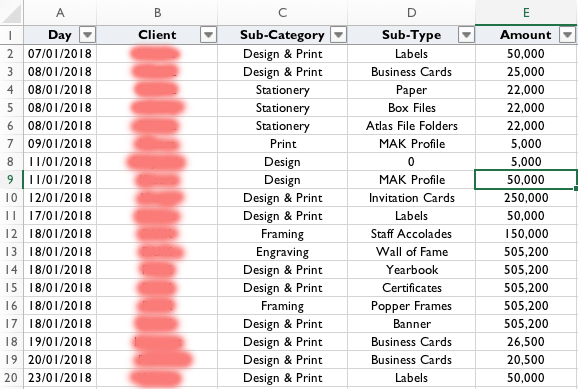
  • Create a new spreadsheet & add data to the tables from the business data source

A sample of data from a book keeping source for business income

  • With the data in place, identify a measurable data point for example days, weeks & months & relate it to another metric for example revenue. Metrics developed from this example are revenue per day, revenue per week or revenue per month. These metrics shape the understanding of business revenue from the defined periods of time.

Commonly Used Metrics

Plenty of metrics are used to measure business activity which vary in application & complexity. A few commonly used metrics include;

Gross Profit

This is the measure of the profit off a sale minus expenses.
A pen bought for sale at 500/- & sold at 1000/- will have a Gross profit of 500/- (1000-500).  
This metric provides an understanding of the profit potential of a business.

Net Profit

This a measure of the general performance of the business.
A pen bought for sale at 500/- & sold at 1000/- with a packaging expense of 400/- will have a Net Profit of 100/- (1000 – (500+400))
This provides an understanding of the viability of the business.

Profit Margins

This measures how profitable the business is. It is represented as a percentage & calculated by dividing the difference between revenue & costs of goods sold by the revenue.
A pen bought for sale at 500/- & sold at 1000/- will have a profit margin of 50% ((1000-500) / 1000).
This metric helps a business understand costing in relation to profitability. Its where the business makes money. A higher margin represents high profitability of a business & vice versa.

Operating Margin

This measures the performance of the business. It is represented as a percentage & calculated by dividing the difference between revenue & the sum of total costs & expenses of the business. The result is represented as a percentage.
A pen bought for sale at 500/- & sold at 1000/- with a packaging expense of 400/- will have an operating margin of 10% (1000 – (500+400) / 1000).
With expenses factored in, the metric gives a general understanding of the business & its activity.

Business Value of Metrics

Metrics provide a business owner with following key benefits;

  • A scientific method to understanding the business, its operation & health
  • Information to make accurate & informed decisions for the business

Thank You for Reading.